How
Should
Charlotte
Manufacturers
Choose
a
Managed
IT
Company?




Charlotte manufacturers should evaluate a managed IT company based on manufacturing experience, support availability and response, cybersecurity capabilities, IT/OT knowledge, proactive technical management, strategic planning, and local service capabilities.
Manufacturing IT extends beyond supporting laptops, email, and Microsoft 365.
A provider may need to manage servers, networks, wireless infrastructure, firewalls, engineering workstations, cloud systems, backup infrastructure, and multiple facilities while coordinating with ERP providers, equipment manufacturers, and other specialized vendors.
Production also changes the impact of technology problems. An unavailable application can affect scheduling, engineering, inventory, shipping, customer communication, or other processes employees rely on to keep operations moving. Manufacturers should ask prospective IT providers how much direct experience they have supporting the industry.
Useful questions include:
AT-NET supports more than 75 manufacturing clients, providing its team with experience across the technology and operational requirements found in manufacturing environments.
Manufacturers do not necessarily operate on an 8-to-5 schedule.
Companies running second or third shifts may need IT support early in the morning, late at night, on weekends, or during holidays. Support availability should therefore reflect the manufacturer actual operating schedule.
Manufacturers should also determine what a provider means by 24/7 support. An internally staffed technical help desk is different from an answering service or an outside organization taking calls after hours.
Response time provides another useful comparison. AT-NET operates an internally staffed 24/7/365 help desk with less than 60-second response. That gives manufacturers a measurable service characteristic rather than a general promise of responsive support.
Escalation procedures matter as well. A routine user issue and a facility-wide network outage have very different business impacts and should have appropriate escalation paths. When comparing MSPs, manufacturers should understand who answers, when they are available, how quickly they respond, and what happens when an issue becomes critical.
Managed IT and cybersecurity are closely connected in manufacturing.
Employees use email and cloud applications. Engineering workstations may contain valuable intellectual property. Servers support business applications. Vendors may remotely connect to equipment. Networks can connect corporate IT with production-related technology. Manufacturers may also face cybersecurity requirements from customers, cyber insurance providers, government contracts, or frameworks such as NIST SP 800-171 and CMMC.
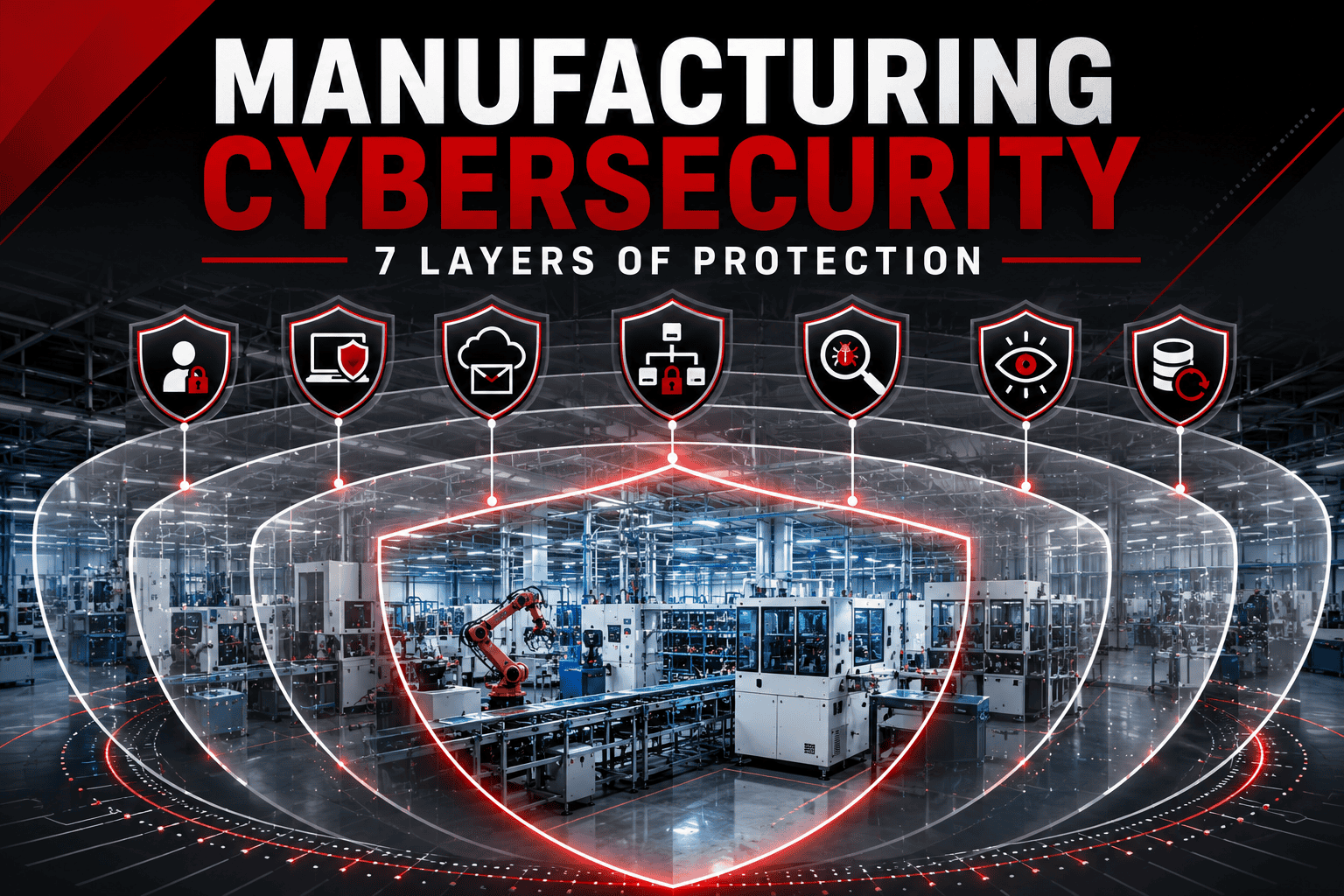
A manufacturing cybersecurity program may include:
Manufacturers should determine exactly which of these protections are included in the managed IT agreement and which require additional services.
This becomes particularly important when comparing prices. A lower monthly proposal may cover user support and basic infrastructure management while excluding MDR, vulnerability management, backup management, security monitoring, or other services the manufacturer still needs. Compare total scope against total scope, not simply one provider monthly price against another.
Manufacturing environments frequently contain connections between traditional information technology and operational technology.
Corporate systems may exchange information with production systems. Engineering workstations may communicate with machinery. Specialized equipment may rely on network connectivity. Equipment vendors may require remote access for maintenance or troubleshooting. Those connections need to be managed carefully.
A vendor that needs access to one machine should not automatically receive broad access to the rest of the corporate network. Remote access should be limited to what is required, appropriately authenticated, and monitored where practical.
Legacy production systems create another challenge. Some manufacturing equipment may depend on older operating systems or applications that cannot be updated as easily as a standard business workstation. Maintenance windows may also need to be coordinated around production.
In those situations, manufacturers may need to use controls such as network segmentation, restricted access, monitoring, or other safeguards to reduce exposure. The managed IT provider does not necessarily replace the machinery vendor or specialized OT provider. It should understand the dependencies and be capable of coordinating with those parties while protecting the broader IT environment.
Managed IT should include more than responding when an employee submits a support ticket.
Manufacturers need someone proactively evaluating the technical environment and identifying issues that deserve attention before they become larger operational problems. AT-NET assigns managed IT clients a dedicated Technical Alignment Manager (TAM).
The TAM works to keep the environment aligned with established technical standards and identify areas that need attention. Depending on the environment, those areas can include infrastructure condition, configurations, cybersecurity controls, documentation, technology lifecycle concerns, and other technical risks.
This creates a different operating model from purely reactive support. Monitoring software may identify that a server is offline or a device is running out of storage. Proactive technical alignment looks more broadly at whether the environment is being maintained according to appropriate standards and where improvements should be planned.
Manufacturers evaluating an MSP should ask: Who is responsible for proactively reviewing our technology environment when nothing is currently broken? The provider should be able to identify both the person or role and the process used.
Day-to-day technical support addresses current issues. Strategic planning helps leadership prepare for what comes next.
AT-NET managed IT clients receive a dedicated vCIO who works with leadership on technology strategy, budgeting, cybersecurity, risk, and future initiatives. A useful planning process should provide visibility across 12, 24, and 36 months.
That roadmap can include aging infrastructure, server replacements, network upgrades, cybersecurity improvements, cloud initiatives, compliance requirements, new applications, facility expansions, business growth and technology budgets.
Longer-term planning is particularly valuable in manufacturing because technology work may need to be coordinated with production schedules. A server, firewall, switch, or other important system reaching end-of-life should ideally appear in the technology budget before it fails.
The same applies to growth. A manufacturer opening another facility, adding a production line, or implementing a new ERP system can identify infrastructure, connectivity, security, and support requirements as part of the project instead of addressing them after implementation.
Simplify your IT management with a dedicated partner delivering exceptional support. Tell us where technology is slowing your business down and we will show you exactly how we would fix it, backed by our 6-Month Client Satisfaction Guarantee.

Expires in


Limited time offer
We rebuilt your site for you. Claim it and we handle everything transfer, hosting, and your domain. Then update it anytime, just by asking AI.
 Claim limited offer now